Presenter: Jo Radner
Telling personal and family stories is fun – and much more. Storytelling connects strangers, strengthens links between generations, and gives children the self-knowledge to carry them through hard times. Knowledge of family history has even been linked to better teen behavior and mental health. In this active and interactive program, storyteller Jo Radner shares foolproof ways to mine memories and interview relatives for meaningful stories. Participants practices finding, developing, and telling their own tales.
Presenter: Jo Radner
Whatever did New Englanders do on long winter evenings before cable, satellite and the internet? In the decades before and after the Civil War, our rural ancestors used to create neighborhood events to improve their minds. Community members male and female would compose and read aloud homegrown, handwritten literary "newspapers" full of keen verbal wit. Sometimes serious, sometimes sentimental but mostly very funny, these "newspapers" were common in villages across Maine, New Hampshire and Vermont and revealed the hopes, fears, humor and surprisingly daring behavior of our forebears. Jo Radner shares excerpts from her book about hundreds of these "newspapers" and provides examples from villages in your region.
Presenter: Jo Radner
Jo Radner shares a selection of historical tales-humorous and thought-provoking-about New Englanders who have used their wits in extraordinary ways to solve problems and create inventions. The stories are engaging and entertaining, but also may raise some profound questions about our admiration of ingenuity and about the ethics of pursuing discoveries without taking their potential outcomes into account. The performance will include discussion with the audience, and may introduce a brief folktale or a poem about inventiveness and problem-solving.
Presenter: Jo Radner
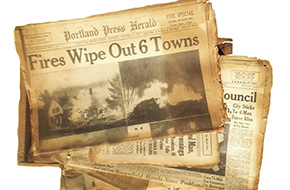
In October 1947, in just a few hours, a terrible wildfire destroyed almost all of the town of Brownfield, in western Maine, including all its churches, schools, post offices, and other public buildings. In the face of the fire, Brownfield residents responded with courage, care, and, in some cases, obstancy—retired schoolteacher Mabel Stone, for instance, chose to stay home with her beloved dog Woofie and fight the fire with a broom, a bucket of water, and her snow rake. Confronting the devastation after the fire, neighbors ingeniously made do, shared what they had, and rebuilt what they could. Jo Radner spent a year interviewing people who experienced the Brownfield Fire, and from those interviews, letters, historical photographs and newspaper reports, created a powerful story of terror, courage, neighborly responsibility, recovery, and – yes – even humor.

Presenter: Jo Radner
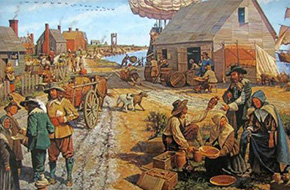
The stories we hear from our families tell us who we are and how we should view the world. What tales shaped New England identities in the 17th and 18th centuries? In this performance, storyteller/historian Jo Radner juxtaposes Native American oral traditions and stories told by her own New England ancestors to reveal a complex colonial "middle ground" in which English settlers and Native peoples saw one another as defenders and trespassers, pursuers and refugees, relatives and aliens, kind neighbors and ruthless destroyers.
Back to Humanities to Go Details