On the Shoulders of Giants: Celebrating Leadership
As we conclude New Hampshire Humanities year-long 50th anniversary, we look back on some of the leaders who played a critical role in advancing the public humanities in the Granite State.
By Dr. Kathy (Smith) Mathis, based on interviews by Marcia Schmidt Blaine, Chair, NHH Board of Directors
Charlie Bickford
Executive Director (1987-2001)
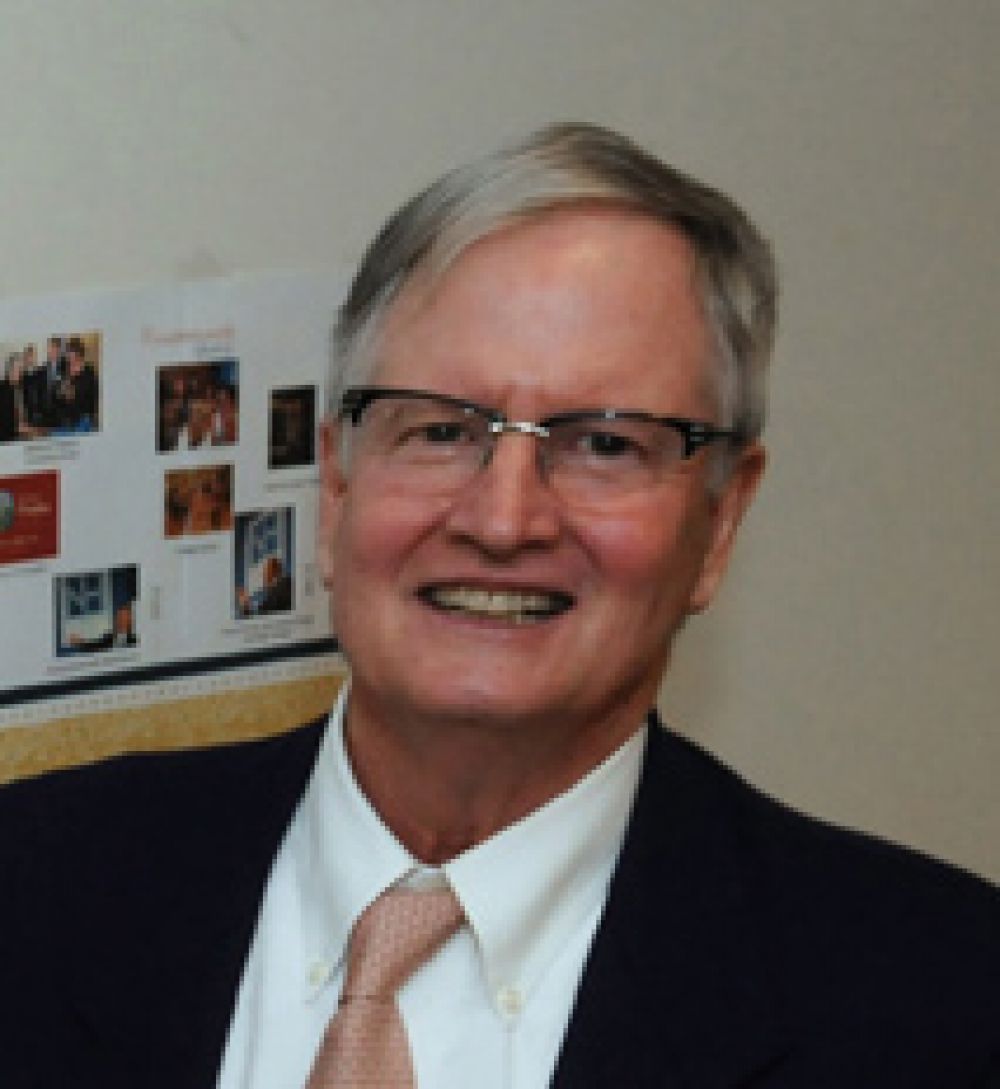 Pluck. Charlie Bickford had it in spades. When he asked people for money, it was as if he was doing them a favor. He always said that people give to people, and because Charlie had become the face of the public humanities in New Hampshire, they gave. The confidence to ask, as donors to nonprofits know, stems from an irresistible product, and the life of the mind, while fairly intangible, was so fecund and alive in Charlie’s mind, that he convinced others that life without literature, without history, without the study of religion, archaeology, art and the classics was a bereft life.
Under Charlie’s tutelage, New Hampshire Humanities grew to be one of the most respected institutions in the state. His vision ran from intuiting and freeing peoples’ talents to hiring staff who made the connections necessary to implement bodacious ideas that no one had thought of before.
He could pick out a winner every time. Charlie saw the promise in Ken Burns, for example, before he became a household name. He visited with Ken six months before the Civil War series was out (Charlie had already helped fund “Hands to Work, Hearts of God,” Ken’s documentary on the Shakers). Charlie asked if Ken would speak at the NHH annual dinner. The keynote would be Lynne Cheney, wife of Dick Cheney and executive director of the National Endowment for the Humanities. Ken would be the secondary “salad” speaker; Charlie was worried that people wouldn’t show up for a little-known local filmmaker. As fate would have it, the Civil War series was released a few weeks before the Annual Dinner and, suddenly, the annual dinner was sold out and 800 people were jammed into the armory at the Manchester Radison. The humanities annual dinner became the must-attend event of the fall in New Hampshire, featuring speakers such as Desmond Tutu (on his 80th birthday), Walter Issacson, Salman Rushdie, Doris Kearns Goodwin, and many others.
Charlie trusted his staff enough to let them loose to create and encourage genius in others. The result was multi-year statewide projects funded by private and federal grants that ran the gamut from the National Science Foundation to the Henry Luce Foundation and the National Endowment for the Humanities.
In the many fruitful years before lock downs and Zoom calls, the council did something that few organizations could pull off: face-to-face meetings that brought people of diverse opinions and backgrounds together to talk about pressing issues of the day, like the history of the Second Amendment and Constitutional legal interpretations handed down by the U.S. Supreme Court. Heavy hitters came to New Hampshire (Sir Arthur Penrose, Stephen J. Gould, Daniel Dennett, for example) to talk about the brain, the mind, artificial intelligence, and human meaning. Armed with texts and group moderators, citizens across the state gathered to talk with civility about the role of religion in politics and public life. There were no right answers but there was a lot of community wisdom.
Of course, no one could do such work alone. And that is where another supercharged talent of Charlie’s was brought to bear in developing “Connecting people with ideas,” a powerful, lived tagline. Collaboration was key to the success of programming. Charlie’s staff cultivated and invested in symbiotic partnerships with universities/colleges, foundations, local groups (libraries, museums, historical societies), and community scholars with great ideas that needed a little organizational support. The symbiosis built upon itself, creating audience appeal. For example, "The Many Faces of God," a study of world religions, looked not only at founding philosophies and sacred texts, but included performances of Indian dance music, Tibetan sand painting, calligraphy, and Oriental flower arranging. The practice of beliefs was another way in to the life of the spirit.
Charlie’s legacy is one he shared with others by putting NHH on the map, cultivating powerful boards and partners, and opening the door to conversations where people turned to one another out of pure interest. He brought a deep sense of purpose, a knowledge of team building, his fiscal sixth sense, and his collegial good humor to institutions of learning that grew from obscurity to respect, from irrelevance to significance and popularity.
Over the course of Dr. Bickford’s 18-year tenure, the New Hampshire Humanities received an unprecedented number of national awards for exemplary public projects in all areas of the humanities. Some highlights include U.S. Constitutional history, “The Ninth State: New Hampshire and the New Nation”; comparative religion, “In the Beginning: Word, Text, Context”; and the history and philosophy of science, “Of Apples and Origins: Stories of Life on Earth,” to name a few.
Charlie worked to elevate the humanities and liberal education in general with enthusiasm, foresight, style, and commitment, taking NHH from a small nonprofit with an annual budget of $850,000 and a staff of four to a nationally-acclaimed agency with double the staff and assets that totaled well over $2l,500,000 when he retired in 2001.
A small footnote: He was good at a lot of jobs after he retired – rescuing nonprofits like Strawbery Banke from the red; making multiple trips to Cambodia to help bring students to the U.S. for study, to name just two – but of New Hampshire Humanities, he says, “It was the best job I ever had.”